
AI tools in M&A: what actually works, and where generic AI falls short
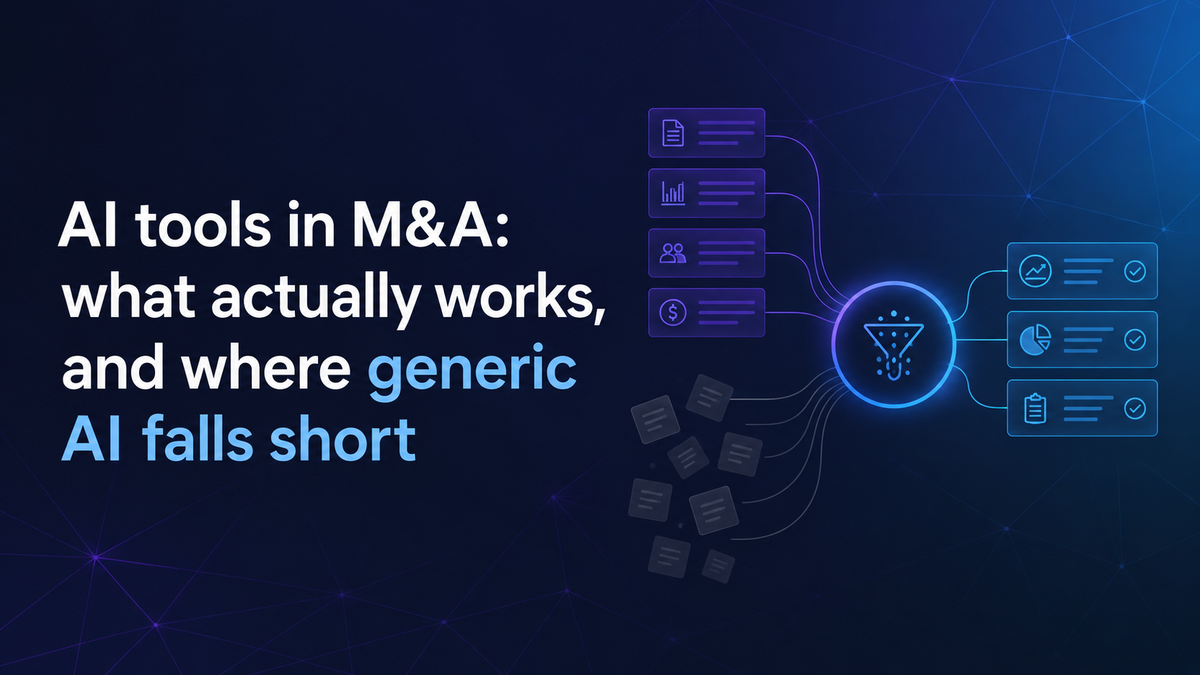
Most M&A teams are now using some form of AI in their workflow. The question is no longer whether to use it. It is which tool for which job, and where the risk of getting it wrong is too high to accept.
This is a practical breakdown of the main options, what each delivers, and where the structural limits are.
The three categories most teams are working with
Traditional databases (Capital IQ, Orbis, Mergermarket). These remain the standard for raw data: financials, ownership, transaction records. The data is verified and sourced. But benchmarking, valuation, and market context still require manual work, which means significant time investment and the usual risk of human error in the process.
General-purpose LLMs (ChatGPT, Copilot, Claude, Gemini). Fast, flexible, useful for drafting and summarising. But in an M&A context, the structural problem is reliability. These models work stochastically: the same prompt produces a different result each time. They have no direct access to verified primary sources. They cannot produce deterministic financial outputs. And there is a real hallucination risk when the model fills gaps with plausible-sounding but fabricated data.
For a first draft or a brainstorm, that is fine. For an IC submission, a fairness opinion, or a board presentation, it is not.
Purpose-built M&A analysis platforms. A newer category, built specifically for the data and workflow demands of professional deal work. Deterministic output, verified sources, M&A-specific financial modeling, and audit-grade documentation. Platforms like StrategyBridgeAI are specifically developed for Corporate Finance.
Where generic AI actually helps in M&A
To be fair to general-purpose tools, there are parts of a deal workflow where they work well:
- Drafting and editing. Information memoranda, management presentations, board materials. LLMs are fast and competent here, as long as a human reviews the output.
- Research orientation. Pulling together publicly available information on a market or sector. Useful for getting started, not for sourcing data points in a valuation.
- Process management. Checklists, workstream tracking, template generation. Low-stakes, high-volume tasks where speed matters more than precision.
The pattern is consistent: generic AI works well where the output does not need to be traced back to a verified source.
Where it breaks down
The real bottleneck in any serious M&A process is not data procurement. It is trust. For investment decisions, board submissions, IC materials, and fairness opinions, every number needs a traceable source. That is where generic tools hit a wall.
Three specific failure modes:
Hallucination risk. LLMs generate confident-sounding outputs that can be factually wrong. In a valuation or peer group analysis, a fabricated revenue figure or misattributed transaction is not just embarrassing. It undermines the entire analysis.
No deterministic output. Run the same prompt twice and you get two different results. That is fine for creative work. It is incompatible with the reproducibility requirements of professional M&A analysis, where the same inputs need to produce the same outputs every time.
No GDPR-safe data handling. Uploading deal-sensitive company data to ChatGPT or Copilot raises real compliance questions. Many firms have already moved to restrict or prohibit this entirely.
What a purpose-built M&A platform delivers differently
This is where the structural difference between a generic AI tool and a specialised platform becomes concrete.
StrategyBridgeAI is an AI-powered analysis platform built specifically for M&A advisors, corporate development teams, private equity, audit firms, and banks. It addresses the three failure modes above directly:
Deterministic, reproducible output. Ten identical inputs produce ten identical outputs. The analysis is reproducible, shareable internally, and stands up when an auditor or IC member asks to see it again next week. No variance, no surprises.
Source citation per data point. Every number in every output traces back to a verified primary source. For auditors, investment committees, and boards, that is not a nice-to-have. It is the baseline requirement for work that carries professional liability.
M&A-specific financial modeling built in. WACC, Beta, Football Field valuations are calculated consistently and automatically, not assembled manually each time by a junior analyst.
Full longlist capability across 50 million companies. Targets, buyers, and competitors are identified via semantic search across private and public companies globally, including niche players that do not appear in keyword-based database searches. Hard filters by revenue, ownership type, geography, and transaction history sit alongside the semantic interface.
GDPR-compliant infrastructure. Hosted on German servers. No data sharing with third parties. Recommended by the Institut der Wirtschaftsprüfer (IDW) and used by more than 150 clients including audit firms, M&A advisors, and banks.
The practical result shows up in how teams describe the change in their work.
"We ran comparison tests and quickly found that the output has very consistent quality and is reliable. I found it very valuable that every number can be traced back to a source. That was important to us."
Hendrik Rathje, Partner M&A, Möhrle Happ Luther
"For us, it is primarily about output quality. Where I still get off-target results from others, with you it is already very close to the mark."
Head of Business Development, global industrial group (DAX environment)
Frequently asked questions: AI tools in M&A
Can ChatGPT be used for M&A analysis?
ChatGPT can support parts of an M&A workflow, particularly drafting, summarising, and research orientation. It cannot reliably produce traceable, source-based financial analysis. Outputs are stochastic, hallucination risk is real, and data uploaded to the platform may not meet GDPR requirements. For IC materials, valuation, or peer benchmarking, a purpose-built platform is required.
What is the best AI tool for M&A target screening?
For systematic target screening and longlist creation, the key requirements are access to verified company data, semantic search across private companies, hard filter logic by financials and ownership type, and Excel export with full data coverage. StrategyBridgeAI is built for exactly this workflow, covering around 50 million companies globally.
How do M&A advisors use AI for valuation?
Leading M&A advisors use AI to automate peer group identification, deterministically calculate valuation multiples and ranges (including WACC, Beta, and Football Field), and benchmark target companies against structural comparables. StrategyBridgeAI delivers this with source citation per data point and output in the advisor's own design, ready for client presentation.
Is AI in M&A GDPR-compliant?
Generic AI tools like ChatGPT and Microsoft Copilot present real GDPR challenges when handling deal-sensitive data. Purpose-built platforms designed for the M&A and audit market, such as StrategyBridgeAI, are hosted on European servers, apply strict data separation, and do not share user data with third parties.
What makes StrategyBridgeAI different from Capital IQ or Orbis?
Traditional databases provide raw data but require manual analysis. StrategyBridgeAI combines verified data with automated benchmarking, valuation, peer group identification, and outside-in company analysis, all in one workflow with deterministic output and source documentation. The result is a full analysis in minutes rather than days.
The decision framework
Use general-purpose AI where speed matters more than precision, and where the output will be reviewed and rewritten before it reaches a decision-maker.
Use a purpose-built platform where the output needs to be traceable, reproducible, and defensible. That covers longlists, peer benchmarking, valuation, outside-in company analysis, and any output that ends up in front of an IC, a board, or an auditor.
Most M&A teams end up using both, for different parts of the process. The mistake is using a generic tool for work that requires a specific one.
See how StrategyBridgeAI works for M&A advisors, corporate development, and private equity.
More from this category
Explore related insights from StrategyBridgeAI.
Build vs. buy: should M&A teams build their own AI or buy a platform?
M&A and corporate development teams all face the same question: build AI in-house or buy a platform. A practical decision framework, and where each option breaks down.
Platform comparison: StrategyBridgeAI vs. Grasp AI
Grasp AI automates research and deal prep at global scale, StrategyBridgeAI combines global coverage with a verified, deterministic analysis approach. A practical comparison.
Platform comparison: StrategyBridgeAI vs. Gain.Pro
Gain.Pro maps the private markets landscape, StrategyBridgeAI connects longlisting, analysis and valuation in one workflow. A practical comparison for M&A, advisory and private equity.