
M&A target screening: how the best deal teams build better longlists faster
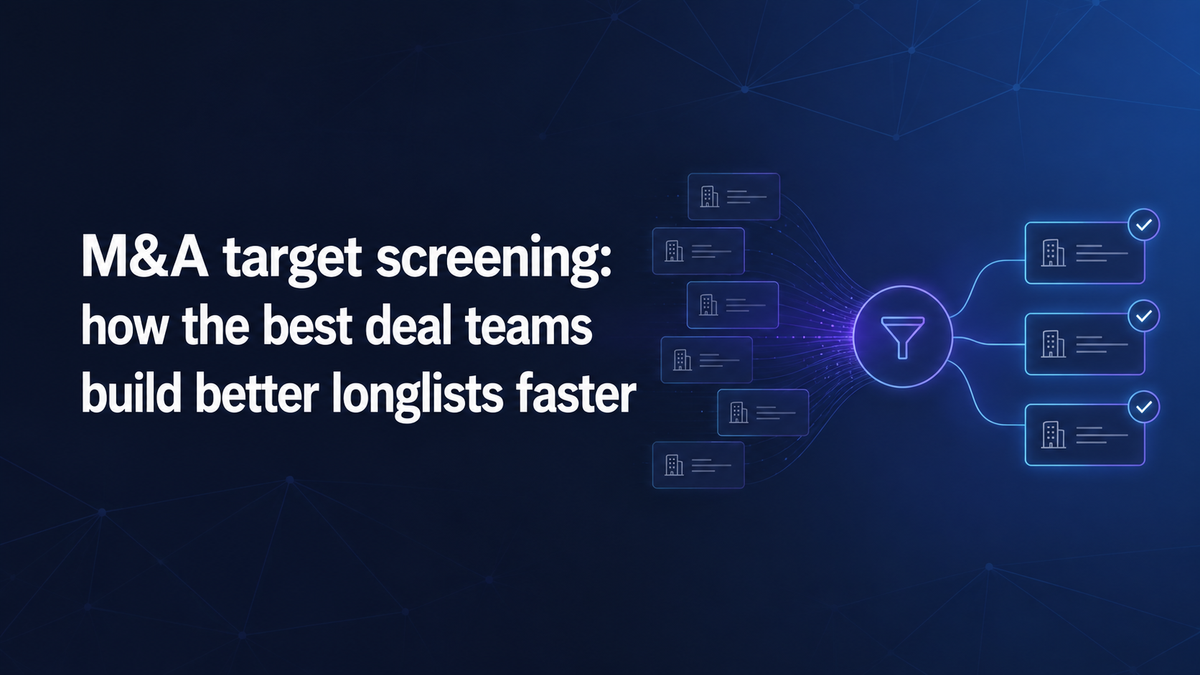
Target screening is where most M&A processes either gain an edge or lose time. A good longlist surfaces companies that genuinely fit the search criteria, including private companies and niche players that standard approaches miss. A weak one produces a list of well-known names that everyone else already has.
This is a breakdown of what a serious screening tool needs to deliver, how modern teams are approaching it, and what separates the tools that hold up in practice.
Why traditional target screening falls short
Most screening approaches start with a sector filter and a revenue range. The result is a list built around whatever classification systems the underlying data uses, which means the output reflects how companies are labelled, not how they actually compete.
That creates two problems. First, companies that operate across sector boundaries, or that sit in niches without a clean classification code, get missed entirely. Second, the list is the same list everyone else with access to the same tool is building.
For mid-market deals in particular, the most attractive targets are often the ones that do not show up in a standard keyword or sector search. Private companies with strong market positions, niche operators with limited online presence, businesses that span multiple verticals. Finding these requires a different approach to search.
What a modern M&A target screening tool needs to deliver
Semantic search, not keyword filters
The shift from filter-based to semantic search is the most significant change in how screening tools work. Instead of selecting a sector code and a revenue bracket, the user describes the business model, market position, customer type, or strategic fit in natural language. The tool then identifies companies that match the description, regardless of how they are classified.
StrategyBridgeAI's Longlist module works via a chat interface. The user inputs a business model description, a market niche, or a strategic profile, and the platform identifies matching companies from an index of around 50 million private and public companies globally. The search can be refined and narrowed through follow-up prompts in the same chat, without starting over.
This approach finds niche players and private companies that are invisible to classification-based screening, and it produces results that reflect actual business model similarity rather than administrative sector codes.
"Longlisting provides us with the greatest added value. We now work systematically rather than subjectively, and much faster."
Dr. Dirk Pramann, Managing Partner, Mition Mittelstandsbeteiligungen
Hard filter logic alongside semantic search
Semantic search and structured filtering work best together. Once a semantic search has identified the relevant universe, hard filters allow teams to narrow by specific criteria without losing the quality of the initial match.
StrategyBridgeAI supports filtering across:
Company characteristics: listed or private status, P&L availability, activity status, ownership type
Geography: region (DACH, Europe ex-DACH, North America, Asia, Africa, Latin America, Oceania), country, city, and postcode
Sector: GICS classification, selectable by sector
Financials: revenue range, EBIT, EBITDA, total assets, with option to include estimates for companies where reported figures are not available
The combination of semantic search and structured filtering means teams can move from a broad universe to a qualified, filterable list without switching tools or starting manual research.
Live data, not cached snapshots
Screening tools built on static data create a gap between what the list shows and what is true today. Company financials change. Ownership structures change. New companies enter markets and others exit.
StrategyBridgeAI pulls from live data sources. Every longlist reflects the state of the market at the point the search is run, not at the point the underlying data was last refreshed. That currency matters especially for fast-moving sectors and for searches where recent activity is a selection criterion.
Ownership data down to the ultimate beneficial owner
Knowing who owns a company is often as important as knowing what it does. For M&A purposes, ownership structure affects deal probability, process complexity, and the right approach to outreach. A family-owned business, a PE-backed company, and a corporate subsidiary each require a different conversation.
StrategyBridgeAI provides ownership data down to the ultimate beneficial owner (UBO) for companies in scope. That means teams can filter and prioritise based on ownership type as part of the screening process, not as a separate research step.
Web enrichment for qualitative depth
Structured data covers financials, ownership, and sector. It does not cover recent strategic moves, management changes, product launches, or market positioning. That qualitative layer often determines whether a company on a longlist is worth pursuing.
StrategyBridgeAI's web enrichment function augments longlist results with current information from company websites, press releases, and other live sources. This can be run via the chat interface, allowing teams to enrich specific companies or the full list with qualitative context as part of the same workflow.
Contact data included
A longlist that does not include a path to outreach creates an additional research step. StrategyBridgeAI provides access to contact data for companies in the results, enabling teams to move directly from screening to first contact without switching tools.
Excel export with full data coverage
Longlists need to be workable. StrategyBridgeAI exports directly to Excel with the full data set included: financials, ownership structures down to UBO, qualitative company information, and contact data. No manual assembly, no reformatting. The export is ready to work with immediately.
"For multiple valuations and longlist research, we have reduced the time required by roughly 85 percent in some cases."
Nikolai Üstündag, Senior Manager Corporate Finance, WTS Advisory
How leading deal teams use target screening in practice
The most effective use of a screening tool is not as a one-time list generator. It is as an ongoing capability that runs through the early stages of a deal process.
Market mapping. Before a target is defined, semantic search can map the competitive landscape of a sector or niche, showing who the relevant players are and how they cluster.
Buy-side screening. With a clear acquisition profile, the longlist function identifies private and public targets that match on business model, size, geography, and ownership type. Niche operators that would not appear in a standard sector search are included in the results.
Sell-side buyer identification. The same logic runs in reverse for sell-side mandates. The platform identifies strategic buyers whose profiles suggest fit with the target, across the same 50 million company universe.
Pitch preparation. A well-structured longlist with financial and ownership data is a credible deliverable in its own right. Teams use the output directly in first client conversations and mandate pitches.
"We now work with higher quality and significantly less time investment."
Holger Danowsky, Co-Founder
Frequently asked questions: M&A target screening
What is M&A target screening?
M&A target screening is the process of identifying companies that match a defined acquisition or partnership profile. It typically involves searching a universe of companies by sector, size, geography, and ownership type, then narrowing to a qualified longlist for further analysis.
What is semantic search in M&A screening?
Semantic search allows users to describe a business model or market position in natural language, rather than selecting predefined filters. The tool identifies companies that match the description based on their actual characteristics, not their sector classification. This surfaces niche players and private companies that keyword or filter-based searches miss.
How many companies does StrategyBridgeAI cover for target screening?
StrategyBridgeAI provides access to around 50 million private and public companies globally, searchable via a semantic chat interface with hard filter logic for geography, financials, ownership type, and sector.
Does StrategyBridgeAI provide ownership data for target screening?
Yes. The platform provides ownership structures down to the ultimate beneficial owner (UBO), which can be used as a filter criterion in the screening process. This data is included in the Excel export alongside financials, qualitative company information, and contact data.
How is StrategyBridgeAI different from standard screening tools?
The main differences are semantic search via chat interface, live data that is current at the point of search, ownership data down to UBO, web enrichment for qualitative depth, and a complete Excel export with financials, ownership, and contact data. The platform finds niche and private companies independently of rigid sector classifications.
More from this category
Explore related insights from StrategyBridgeAI.

How to find off-market acquisition targets
The best acquisitions are often the ones nobody else was bidding on. Here is how deal teams find off-market targets: the channels, the target universe, and a repeatable workflow.
AI in distressed M&A: how to spot turnaround targets and assess solvency risks faster
How AI-driven data platforms help M&A and restructuring teams source turnaround targets earlier and assess solvency risk before the deal process begins.
How corporate development teams build a scalable deal origination engine
Systematic deal origination separates high-performing M&A teams from reactive ones. Here is how mid-market PE and corp dev teams build a repeatable sourcing process, and what tools make it work.