
Company benchmarking tools for M&A: a practical breakdown and what to look for
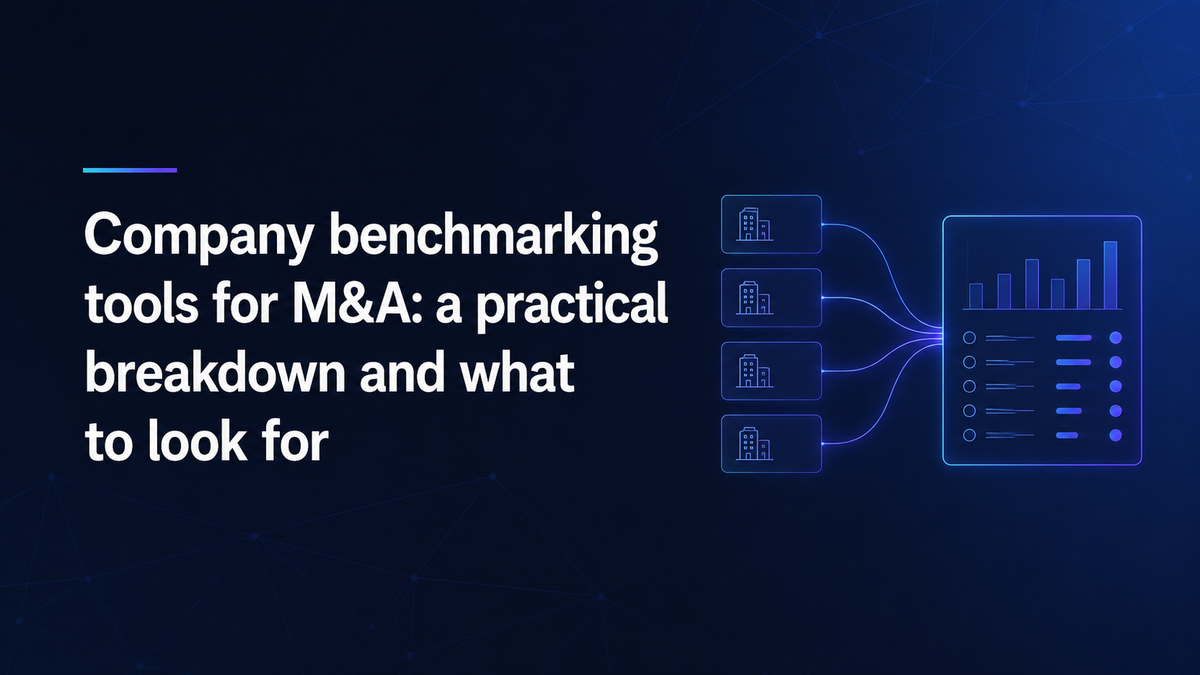
Benchmarking is one of those tasks that looks straightforward on paper and turns out to be one of the most labour-intensive parts of a deal or advisory process in practice. Finding the right comparables, pulling consistent financial data, and producing a defensible output takes time that most teams do not have.
The tools available have improved. But the gap between a benchmarking tool that generates a sector average and one that delivers analysis a client or investment committee can actually rely on is significant. This is a breakdown of what that gap looks like and what a serious tool needs to deliver.
Why benchmarking is harder than it looks
The core challenge is peer selection. If the peer group is wrong, everything that follows is wrong. Margins, multiples, growth rates, and valuation ranges all depend on comparing a company against businesses that are structurally similar, not just in the same sector code.
Most approaches use sector classifications as a proxy for comparability. The problem is that a sector code can group companies with very different business models, customer types, and margin profiles. A niche industrial manufacturer and a broad-based distributor may share a NACE code and have almost nothing else in common.
The second challenge is data consistency. Benchmarking across private companies requires data that is comparable in methodology, not just available. Revenue figures sourced from different reporting standards, different fiscal years, or different estimation methods produce noise, not insight.
What a serious benchmarking tool needs to cover
Peer identification based on business model, not sector code
The starting point is finding the right comparables. A benchmarking tool that relies solely on sector classification will systematically produce peer groups that are too broad. Business model similarity, customer structure, geographic footprint, and margin profile are better indicators of who a company actually competes with.
StrategyBridgeAI's Hawk Eye identifies peers using semantic analysis of business model characteristics across a universe of around 50 million private and public companies. The peer group reflects actual competitive proximity, not administrative classification. For niche businesses and mid-market companies where sector codes provide limited signal, this distinction matters a great deal.
Financial benchmarking with direct peer comparison
Once the peer group is established, the analysis needs to benchmark the target company across the financial KPIs that matter for the decision at hand. That means margins (gross, EBIT, EBITDA, net), growth rates, capital efficiency, leverage, and return metrics, tracked consistently over time and compared against direct peers as well as the broader sector.
Hawk Eye delivers this as a structured, visual output. The benchmarking section shows where a company sits relative to its direct competitors, its sector, and the broader market, across multiple KPIs and across time. The output makes it immediately clear where a company leads, where it lags, and what the trend has been.
"We are significantly faster and have access to more comprehensive, structured data for longlists, benchmarking and valuation."
Dr. Volker Riedel, Dr. Wieselhuber & Partner
Market and sector analysis in the same workflow
Benchmarking does not exist in isolation. Understanding where a company sits relative to its peers only makes sense in the context of what the market is doing. Sector dynamics, entry barriers, growth drivers, and competitive intensity all shape what the numbers mean.
Hawk Eye includes a sector and market analysis module that covers market structure, growth trends, value chain dynamics, and competitive overview. This sits in the same workflow as the financial benchmarking, so the analyst does not need to source market context separately or reconcile it with the benchmarking output afterwards.
Valuation grounded in the peer analysis
Multiples-based valuation is only as reliable as the peer group and the data it is based on. Hawk Eye's valuation module calculates indicative enterprise value using trading and transaction multiples derived from the identified peer group. The methodology is transparent: every multiple is traceable to its source, size adjustments are documented, and the implied valuation range is presented alongside the underlying assumptions.
This is the difference between a valuation that holds up when challenged and one that does not. For investment committees, fairness opinions, and credit decisions, traceability is not optional.
Forecasting to validate management plans
One of the most practically useful applications of benchmarking in an M&A context is validating management forecasts. If a target's business plan projects margin expansion or revenue growth that sits well outside the range achieved by structurally comparable companies, that is a red flag worth surfacing early.
Hawk Eye's forecasting module benchmarks projected financial performance against peer trends and market data. Management projections are compared against what comparable companies have actually achieved, making optimistic assumptions visible before they become a problem in the process.
Output in the client's own design, ready to present
Analysis that needs significant reformatting before it reaches a client adds time and creates version control risk. Hawk Eye outputs are delivered directly in the user's own PowerPoint design, with charts, graphics, and formatting included. From the platform to a client-ready presentation without manual reconstruction.
"Analyses are now available faster and at the same time much more comprehensive than before."
Tobias Nellinger, Partner, dhmp
Audit-grade quality: what it means in practice
Benchmarking used in professional contexts, whether for a valuation opinion, a credit decision, or an IC presentation, needs to meet a higher standard than analysis used for internal orientation.
Audit-grade output means three things. Every data point traces back to a verified primary source. The methodology is documented and reproducible. And the output is consistent: identical inputs produce identical outputs, regardless of when the analysis is run or who runs it.
StrategyBridgeAI is listed by the Institut der Wirtschaftsprüfer (IDW), which reflects the quality and traceability standard the platform is built to. For audit firms, advisory firms, and corporate teams whose benchmarking work carries professional liability, that is not a marketing point. It is a baseline requirement.
How teams use Hawk Eye in practice
CDD and red flag due diligence. Outside-in benchmarking surfaces risk early. Margins that look strong relative to management commentary often look different when compared against a properly constructed peer group.
Valuation support. Peer multiples derived from structurally comparable companies produce more defensible valuation ranges than broad sector averages. The traceable output holds up when the methodology is challenged.
Pitch and IC preparation. A complete competitive and financial benchmarking output, delivered in the client's design, reduces the time from analysis to presentation significantly. Teams report going from 20 to 80 hours of manual work to 15 to 30 minutes for a full outside-in assessment.
Management plan plausibility. Projections are compared against peer trends systematically, not by analyst judgment alone.
Frequently asked questions: company benchmarking tools for M&A
What is a company benchmarking tool in M&A?
A company benchmarking tool identifies structurally comparable companies and analyses the target's financial performance relative to that peer group. In an M&A context, this covers margins, growth, capital efficiency, valuation multiples, and market position. The output informs investment theses, valuation opinions, and due diligence assessments.
How does peer group selection work in benchmarking tools?
Most tools use sector classification codes to identify peers. More advanced platforms use semantic analysis of business model characteristics to find companies that are genuinely comparable, regardless of how they are classified. This produces more accurate benchmarks, particularly for niche or mid-market companies.
What makes benchmarking output audit-grade?
Audit-grade benchmarking requires traceable sources for every data point, documented and reproducible methodology, and consistent output from identical inputs. StrategyBridgeAI meets this standard and is listed by the Institut der Wirtschaftsprüfer (IDW).
How does StrategyBridgeAI approach company valuation in benchmarking?
Hawk Eye calculates indicative enterprise value using trading and transaction multiples derived from the identified peer group. Methodology is transparent, size adjustments are documented, and the valuation range is presented alongside its underlying assumptions, making it defensible in professional contexts.
How long does a full outside-in benchmarking analysis take with StrategyBridgeAI?
Users report completing a full outside-in analysis including peers, benchmarking, sector analysis, valuation, and forecasting in 15 to 30 minutes. The output is delivered in the user's own PowerPoint design and is immediately presentable to clients.
Explore the Hawk Eye module and the full StrategyBridgeAI platform.
More from this category
Explore related insights from StrategyBridgeAI.
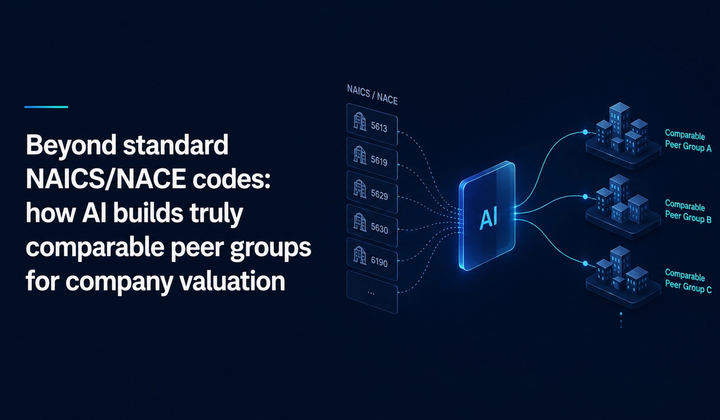
Beyond standard NAICS/NACE codes: how AI builds truly comparable peer groups for company valuation
Classic NAICS/NACE codes lump niche providers into peer groups that don’t fit. See how AI-driven classification builds comparables analysts can confidently defend.
Automated commercial due diligence: how AI helps strategy teams validate market assumptions in hours instead of weeks
Commercial due diligence isn’t slowed down by analysis, but by research. See how AI helps strategy and M&A teams validate markets in hours instead of weeks.
Company valuation tools for M&A: a practical breakdown and what to look for
Valuation is where deal decisions get made and defended. Here is a practical breakdown of what valuation tools need to deliver for M&A, PE, and advisory teams, and which approach holds up best.